
You’re scrolling through Instagram, someone drops “NFS” in the comments, and you freeze. Do you like it? Reply? Pretend you understood it? If that sounds familiar, you’re not alone — “what does NFS mean in texting” is one of the most searched slang online right now, and for good reason.
This little three-letter combo shows up everywhere: text messages, TikTok captions, DMs, dating apps, and even workplace chats. And depending on where you see it, it can mean something completely different. That’s the tricky part.
By the time you finish reading this, you’ll know exactly what NFS means, how to use it confidently, when to avoid it, and how to respond when someone throws it your way. No confusion, no second-guessing.
What Does NFS Mean in Texting – Quick Meaning
At its most common, NFS stands for “Not For Sale.”
But that’s just the beginning. Context is everything with this one.
Here are the most widely used meanings of NFS in texting and online communication:
- Not For Sale – the item, feeling, or thing being discussed isn’t available
- No Funny Stuff – being serious, no jokes right now
- Need For Speed – referring to the video game franchise
- Not For Sure – expressing uncertainty (less common but used)
- No Filter Sunday – a social media trend of posting raw, unedited content
Quick Examples In Context:
- “That jacket is NFS, I’ve had it since high school.”
- “I’m serious about this, NFS.”
- “Has anyone else been playing NFS: Unbound all week?”
The meaning almost always clicks once you read the full sentence around it.
Origin and Background of NFS
NFS didn’t emerge from a single moment — it grew organically across multiple countries and communities at the same time, which is why it carries different meanings depending on where you encounter it.
“Not For Sale” has its roots in online marketplaces and collectors’ communities. Platforms like eBay, Facebook Marketplace, and Reddit’s buy/sell/trade threads made “NFS” a natural shorthand when someone posted a photo of something they owned but weren’t willing to sell. Sneakerheads, vintage clothing collectors, and car enthusiasts adopted it early and spread it fast.
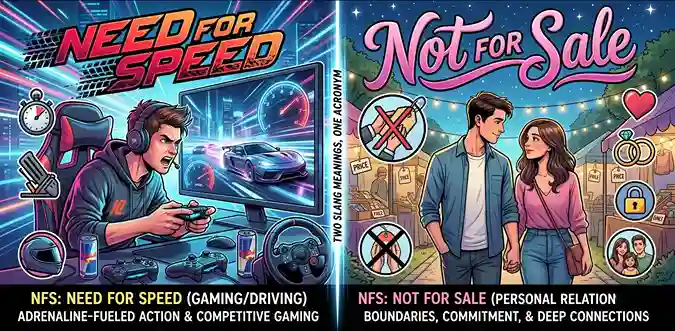
Around the same time, gaming culture was making “Need For Speed” a household name. The racing game franchise, which launched in 1994, became so embedded in teen and young adult culture that “NFS” became nearly synonymous with it in gaming forums and early social media spaces.
The “No Funny Stuff” meaning came from a different direction — casual text conversations where someone needed to signal they were done joking. It carries a slightly firmer emotional weight, the kind you use when you want a real answer from someone.
Social media — especially Instagram — gave rise to “No Filter Sunday”, a content trend where people post authentic, unedited photos to push back against the polished, curated norm. That hashtag culture pulled NFS into a whole new direction.
Today, NFS lives across all these meanings simultaneously. Gen Z and millennials move fluidly between them, reading context instinctively.
Real-Life Conversations Using NFS
Nothing explains slang better than seeing it used naturally. Here are four realistic conversations where NFS appears the way real people actually use it.
Conversation 1 — WhatsApp (Marketplace inquiry)
1st Person: Hey, I saw your post about the PlayStation 5. Is it still available?
2nd Person: The console, yes, but the controllers and the games are NFS. I’m keeping those.
1st Person: Got it, how much for just the console?
Conversation 2 — Instagram DM (Admiring someone’s outfit)
1st Person: Omg, where did you get that leather jacket?? 😍
2nd Person: Lol, it’s NFS, thrifted it years ago, and I will literally never part with it
1st Person: Okay, but if you ever change your mind… 👀
Conversation 3 — Text message (Serious conversation)
1st Person: Are you actually okay? Because you seem off lately
2nd Person: Honestly, no. And NFS — I’m tired of pretending everything’s fine
1st Person: I figured. Tell me what’s going on.
Conversation 4 — TikTok comment section (Gaming video)
1st Person: What game is this??
2nd Person: NFS Unbound, it’s been my whole personality lately lol
1st Person: The graphics on that one are insane
Each of these conversations shows how NFS shifts in tone and meaning without anyone needing to explain it. The surrounding words do all the heavy lifting.
Emotional and Psychological Meaning Behind NFS
There’s something quietly powerful about “NFS” that goes beyond simple shorthand.
When someone says something is “not for sale,” they’re drawing a line. It’s a way of saying: this matters to me, and I’m not negotiating. Whether it’s an object with sentimental value or a personal boundary, NFS communicates attachment and self-awareness at the same time.
The “No Funny Stuff” version carries something heavier — a kind of vulnerability. It’s what you say when you need the other person to meet you where you are emotionally. It signals that you’re putting down the armor for a second and asking for a real connection.
There’s a psychological intimacy in that. In a world where most digital communication defaults to humor and deflection, saying “NFS” in a serious context is actually an act of openness. It says: I trust you enough to stop joking.
I remember once texting a close friend after a rough week at work. She responded, “NFS though — are you actually handling it or just saying you are?” That two-letter prefix changed the whole direction of the conversation. It asked for honesty without making it feel like a confrontation.
That’s the quiet power of slang done right. It carries emotional nuance in the smallest package.
How NFS Is Used in Different Contexts
On Social Media
NFS appears constantly on Instagram, TikTok, and X (formerly Twitter). Sellers use it in marketplace-style posts to show something isn’t available. Content creators use it in captions to mark personal items they’ve been asked about. It’s clean, recognizable, and doesn’t require explanation if your audience already knows the culture.
With Friends & in Relationships
In personal conversations, NFS often carries more weight. Used between close friends, it signals honesty and seriousness. In romantic contexts, “NFS” can pop up when someone is setting a tone, making clear that what they’re about to say is genuine.
In Work or Professional Settings
NFS rarely belongs in professional communication, and when it does appear, it’s almost always in a creative, startup, or digital-native work culture. A social media manager might caption a post “NFS vibes only today” for a brand that has that personality. In formal emails or serious business chats, though, it would feel jarring and out of place.
Casual vs. Serious Tone
The beauty of NFS is that tone usually announces itself. “NFS lol” is light and breezy. “And I mean that — NFS” is firm and direct. Reading the energy of what surrounds it usually tells you everything.
When NOT to Use It
Even widely understood slang has limits, and NFS is no exception.
Formal Or Professional Settings
Emails to clients, job applications, and presentations — keep NFS out of these entirely. Even if the meaning is technically clear, it signals a lack of professional awareness.
When Talking To Someone Unfamiliar With Internet Culture
Older relatives, people who don’t use social media heavily, or anyone from a different digital background might read NFS as a typo or error rather than intentional slang.
When You Need Absolute Clarity
If you’re negotiating something real — a business deal, a financial arrangement, a serious personal conversation — spell it out. “This is not for sale” or “I’m not joking about this” leaves no room for misinterpretation.
Cross-Cultural Conversations
In some languages and cultures, abbreviations like these don’t translate, and attempting to use them can come across as dismissive or confusing.
Common Misunderstandings
The biggest misread with NFS is assuming there’s only one meaning. Someone posting a photo of their car collection and writing “all NFS” is clearly using “not for sale.” But someone texting “NFS, I’m done waiting” is setting a serious emotional tone. Confusing the two can make you look like you weren’t paying attention.
Another common mistake: taking NFS too literally in playful conversations. If a friend captions a selfie “honestly NFS today,” they probably mean they’re feeling themselves and not trying to sell anything — it’s self-assured humor, not a marketplace announcement.
The tone confusion is real. NFS can sound dismissive in the wrong context. If someone’s asking for emotional support and you reply with a casual NFS, you might accidentally signal that you’re not taking them seriously.
When in doubt: slow down, read the full message, and let the context guide you.
Comparison Table
| Term | Meaning | Tone | Common Platform |
| NFS | Not For Sale / No Funny Stuff | Firm, personal | Instagram, WhatsApp, TikTok |
| NGL | Not Gonna Lie | Honest, casual | Everywhere |
| IJS | I’m Just Saying | Defensive, casual | Twitter/X, texts |
| FR | For Real | Emphasis, sincere | Universal |
| FS | For Sure | Confirming, casual | Opposite of NFS |
| OBO | Or Best Offer | Negotiable, open | Marketplace platforms |
| HMU | Hit Me Up | Inviting, casual | DMs, stories |
| NVM | Never Mind | Withdrawal, dismissal | Texts, DMs |
Key Insight
What makes NFS stand apart from most slang is its versatility across very different emotional registers. It can anchor a marketplace post with zero emotion, or carry real weight in a vulnerable conversation. Most slang lives in one lane — NFS comfortably drives in several.
Variations and Types of NFS (8–10 Forms)
Understanding NFS means understanding its range. Here are the most common forms and how each one functions:
- NFS – Not For Sale — The classic. Used when showing something you own but aren’t willing to give up. Common in collector, vintage, and resale communities.
- NFS – No Funny Stuff — Used to signal seriousness in a conversation. Often appears before or after a personal disclosure or firm statement.
- NFS – Need For Speed — Gaming shorthand. Almost exclusively used in gaming communities, forums, and content about the racing franchise.
- NFS – No Filter Sunday — A social media content movement. Used with unedited photos posted on Sundays as an act of authenticity.
- NFS – Not For Sure — A less common usage, but it does appear in casual texting when someone is uncertain and wants to soften their answer.
- NFS – No Free Stuff — Used occasionally in business or creative contexts when setting expectations for what’s included in a service or exchange.
- NFS – Not Following Sorry — Rare, but used in early social media culture when declining a follow request politely.
- NFS – New Friend Situation — Used in some online social communities to describe a new or developing friendship, especially in group chats.
- NFS – Night Feels Strange — Creative, poetic usage found in music and art communities, often in captions or lyrics referencing late-night emotional states.
- NFS – No Further Steps — Appears in customer service and tech support contexts to indicate a process is complete, and nothing else is needed.
How to Respond When Someone Uses It
The right response to NFS depends entirely on what meaning is in play.
“Not For Sale”:
- Casual: “Okay, okay, respect the collection 😭”
- Funny: “Everything has a price… I’ll find it eventually lol.”
- Respectful: “Totally get it, thanks for letting me know anyway!”
“No Funny Stuff” (serious conversation):
- Casual: “Say less, I’m listening.”
- Mature: “Got it. No jokes. What’s going on?”
- Respectful: “Of course. I’m here, and I’m taking this seriously.”
If it’s about a video game (Need For Speed):
- Casual: “Bro, same, I’ve been on it all week.”
- Funny: “NFS was my whole childhood, don’t even start.”
- Neutral: “Which version? The newer ones are different.”
Regional and Cultural Usage
Western Culture (US, UK, Australia)
In Western markets, NFS most commonly signals marketplace culture — think Depop, Facebook Marketplace, and Craigslist. It’s baked into the language of resale and collecting. The “No Funny Stuff” meaning is also widely understood in American English, particularly among millennials and Gen Z.
Asian Culture
In markets like South Korea, Japan, and Southeast Asia, internet slang tends to develop independently in local languages, but English slang like NFS does circulate — especially among younger, globally connected users on platforms like TikTok and Instagram. “Not For Sale” translates cleanly across cultures as a concept, even if the abbreviation itself is English-native.
Middle Eastern Culture
In Arabic-speaking communities online, English slang travels primarily through entertainment, gaming, and global social media. NFS in the gaming sense (Need For Speed) has broad recognition because the franchise itself was hugely popular in the region. The conversational uses are less widespread but growing as English digital fluency increases.
Global Internet Usage
On platforms without geographic boundaries — Reddit, YouTube, TikTok — NFS is understood almost universally in its “Not For Sale” and gaming forms. The global resale and collector economy has made that meaning genuinely international.
Generational Differences
Gen Z encounters NFS most often in marketplace and aesthetic contexts — it’s the language of thrift culture and curated identity. Millennials are more likely to associate it with Need For Speed (nostalgia) or the “No Funny Stuff” usage in serious conversations. Older generations largely haven’t absorbed it yet, which is worth keeping in mind when choosing your audience.
Is It Safe for Kids?
Yes — in most contexts, NFS is completely appropriate for children and teenagers.
“Not For Sale” and “Need For Speed” are neutral, harmless phrases. Even “No Funny Stuff” is simply a direct way of saying “be serious,” which is perfectly appropriate.
The only caution worth noting: context awareness. Younger kids might use NFS without fully understanding the tone they’re setting — particularly “No Funny Stuff,” which can come across as curt or dismissive if they use it in the wrong moment. A quick explanation of context can go a long way.
For parents: NFS isn’t a flag for concern. It’s mainstream digital vocabulary that’s more about self-expression and marketplace culture than anything problematic.
FAQs
What Does NFS Slang Mean In Text?
NFS most commonly means “Not For Sale” in texting — used to indicate that something someone owns or feels isn’t available or up for negotiation. It also frequently means “No Funny Stuff,” used when someone wants to signal that they’re being serious. The meaning depends almost entirely on context.
What Does NFS Mean In Internet Slang?
In internet slang, NFS typically signals “Not For Sale,” especially in online marketplace communities, collector groups, and resale platforms. It’s one of the most common terms in thrift, sneaker, and vintage communities online.
How Is NFS Used In Texting?
NFS is used in texting to quickly communicate one of several things: that something isn’t for sale, that a person is being serious (no jokes), that they’re referring to the Need For Speed video games, or that they’re participating in No Filter Sunday content. Which meaning applies is usually clear from the surrounding message.
What Does NFS Mean On A Dating App?
On dating apps, NFS typically means “No Funny Stuff” — a way of saying the person is looking for something genuine, not casual games or superficial conversation. It sets a tone of directness and seriousness early in the interaction.
What Is NFS On Instagram?
On Instagram, NFS has two main lives. It appears in posts and stories to mean “Not For Sale” when someone is sharing an item they don’t want to sell. It also connects to the “No Filter Sunday” trend, where people post unedited, authentic content as a counter to the platform’s typical polished aesthetic.
What Does NFS Mean Online?
Online, NFS broadly means “Not For Sale” in marketplace and community contexts, and “No Funny Stuff” in conversational ones. Gaming communities use it specifically for Need For Speed. The term is flexible and context-dependent, making it one of the more versatile pieces of digital shorthand in current use.
Conclusion
Language is always moving, and slang like NFS captures something real about how we communicate now — fast, layered, and deeply contextual. A single three-letter phrase can tell someone their offer has declined, signal the end of joke-mode, or spark a conversation about a favorite video game from 2003. That kind of flexibility is actually impressive.
What makes NFS worth understanding isn’t just the mechanics of what it means — it’s what it reflects about modern digital communication. We’ve gotten incredibly efficient at packing emotion, tone, and intention into tiny abbreviations. And once you’re fluent in that language, you navigate conversations with a lot more confidence.
So next time NFS pops up in a message, a caption, or a comment — you’ll know exactly what to do with it.
Use it naturally, read the room, and trust the context. You’ve got this.