
What does PM stand for in text? If you’ve ever received a message saying “PM me,” “send me a PM,” or simply “PM later,” you’re not alone in wondering what it actually means. The phrase appears everywhere — from Instagram and TikTok to work chats and gaming communities.
The confusion happens because “PM” can mean different things depending on the context. Sometimes it refers to a private message. Other times, it points to time, like “4 PM.” In professional spaces, it may even mean project manager or prime minister.
But in texting and social media culture, the most common meaning is surprisingly simple.
Understanding how people use “PM” helps you avoid awkward misunderstandings and communicate more naturally online. It also reveals something interesting about modern communication: people increasingly value speed, privacy, and emotional convenience in digital conversations.
What Does PM Stand for in Text? – Quick Meaning
In texting and online conversations, PM usually stands for “Private Message.”
It means someone wants to continue the conversation privately instead of publicly.
Simple Definition
- PM = Private Message
- Used on social media, forums, gaming apps, and texting
- Suggests a one-on-one conversation
Common Examples
- “PM me the details.”
- “I’ll send you a PM.”
- “Can you PM your address?”
In some contexts, PM may also mean:
- Post Meridiem (time after noon)
- Project Manager
- Prime Minister
Still, in casual texting, “private message” is the dominant meaning.
Origin and Background
The term “PM” became popular during the early internet era, especially in online forums and chat rooms from the late 1990s and early 2000s.
Back then, public discussion boards allowed users to communicate openly in threads. But when conversations became personal, users shifted to direct communication through a “private message” feature. Instead of typing the full phrase repeatedly, people shortened it to “PM.”
As social media evolved, the term spread rapidly across:
- Twitter/X
- Discord
- Gaming communities
The rise of smartphones accelerated the habit. Modern communication rewards speed and brevity. Abbreviations like PM became part of internet culture because they save time while sounding casual and familiar.
Social media also changed the emotional meaning of PMs. Private messaging now represents more than convenience. It often signals trust, exclusivity, flirtation, or confidentiality.
For many people, moving from public comments to PMs feels like entering a more personal space.
Also Read: What Does NFS Mean in Texting? Full Slang Guide
Real-Life Conversations
WhatsApp Conversation
1st Person:
“Hey, I didn’t want to say this in the group chat. Can I PM you?”
2nd Person:
“Sure, what happened?”
Instagram DM Example
1st Person:
“You look amazing in your latest post.”
2nd Person:
“Aw thank you.”
1st Person:
“I’ll PM you later. I wanted to ask something privately.”
TikTok Comment Section
1st Person:
“Where did you buy that jacket?”
2nd Person:
“PM me. The link gets removed in the comments.”
Text Message Example
1st Person:
“Can you PM me your new number?”
2nd Person:
“Yep, sending now.”
These conversations feel natural because PM is now deeply integrated into online communication habits.
How Do You PM Someone
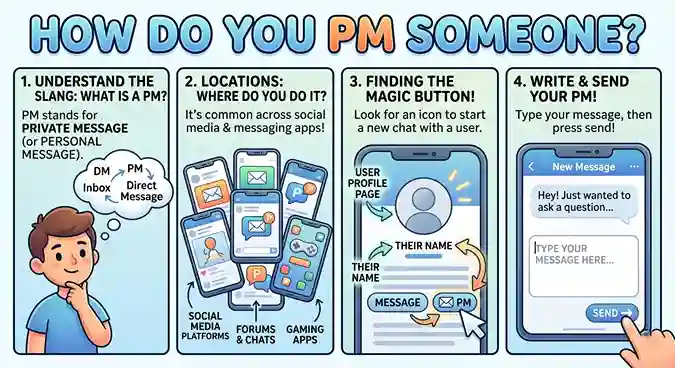
To PM someone, open the messaging section of the app or social platform, select the person, and send a private message directly. Most apps include direct messaging features for private conversations.
Emotional and Psychological Meaning
At first glance, PM seems purely functional. But emotionally, it often carries deeper meaning.
When someone says “PM me,” they may be expressing:
- Trust
- Privacy
- Curiosity
- Emotional caution
- Romantic interest
- Professional discretion
Moving a conversation into private messaging creates psychological intimacy. It separates two people from the public environment.
That’s why the phrase can sometimes feel exciting or serious depending on context.
For example, imagine posting a vulnerable thought online and receiving:
“Hey, PM me if you need to talk.”
That message feels personal because it offers emotional safety away from public attention.
Modern communication increasingly blends public performance with private emotion. PM culture reflects that shift perfectly.
Usage in Different Contexts
Social Media
On platforms like Instagram, TikTok, Reddit, and Facebook, PM almost always means private message.
Examples:
- “PM for prices.”
- “PM me the link.”
- “Check your PM.”
It’s commonly used by creators, buyers, online communities, and influencers.
Friends & Relationships
Among friends, PM often signals personal conversation.
Examples include:
- Sharing gossip
- Discussing feelings
- Planning surprises
- Giving emotional support
In dating culture, “PM me” can sometimes hint at romantic interest or a desire for deeper connection.
Work & Professional Settings
In workplace communication, PM may mean:
- Private message
- Project manager
Context matters heavily here.
For example:
“Please PM me the report.”
Means private message.
But:
“The PM approved the timeline.”
Means project manager.
Professional environments usually require clarity to avoid confusion.
Casual vs Serious Tone
PM can sound:
- Casual and friendly
- Professional
- Secretive
- Supportive
Tone depends on wording and relationship dynamics.
“PM me later lol” feels relaxed.
“Please PM me immediately” sounds more urgent and serious.
PM Meaning in Work
In workplace and business settings, PM can have several meanings depending on the industry and context. It often stands for Project Manager, referring to the person responsible for managing projects, or Project Management, which involves planning and coordinating tasks. In office chats, PM may also mean private message.
When NOT to Use It
Although PM is common, there are situations where using it may create problems.
Formal Business Communication
In highly formal emails or official documents, spelling out “private message” sounds more professional.
Sensitive Situations
Telling someone to “PM me” during serious public discussions can appear dismissive or secretive.
Cross-Generational Communication
Older users may misunderstand the abbreviation entirely.
Cultural Confusion
Not every region uses PM the same way. Some people immediately think of time rather than messaging.
Educational Settings
Teachers or institutions sometimes discourage unclear abbreviations because they reduce communication clarity.
Using full wording avoids misunderstandings.
Common Misunderstandings
One major issue with PM is that it has multiple meanings.
PM vs Time
Some people interpret PM as evening time.
Example:
“Meet at 7 PM.”
This has nothing to do with messaging.
PM vs Private Message
In texting:
“PM me.”
Clearly means private message.
Tone Misunderstandings
Sometimes “PM me” may sound suspicious, flirtatious, or overly secretive depending on context.
Platform Confusion
Different apps use different terms:
- DM = Direct Message
- PM = Private Message
- Inbox = Message request
People often assume they all mean exactly the same thing, but platform culture changes nuance slightly.
What Does PM Mean on Snapchat
On Snapchat, PM stands for private messages. Users commonly use it when asking someone to move a public conversation into direct messages. It helps keep chats private between users instead of sharing them publicly.
What Does PM Me Mean on Facebook
On Facebook, “PM me” means “send me a private message.” It is used when someone wants to continue a conversation privately instead of replying publicly in comments. The message is usually sent through Facebook Messenger, allowing one-on-one communication between users. People often use “PM me” for personal discussions, questions, or sharing information privately.
Meaning of PM in WhatsApp Chat
In WhatsApp chat, PM usually means private message or personal message. It refers to sending a direct message privately instead of posting in a group chat. People often use “PM me” when they want to continue a conversation one-on-one.
Comparison Table
| Expression | Meaning | Tone | Common Platform |
| PM | Private Message | Neutral | Forums, Facebook |
| DM | Direct Message | Casual | Instagram, TikTok |
| Inbox me | Send message privately | Friendly | |
| Text me | Send SMS/message | Personal | Mobile texting |
| Public comment | Open conversation | Visible | Social media |
| Chat me | Start conversation | Informal | Messaging apps |
| Ping me | Contact me quickly | Professional/casual | Slack, Discord |
| Ghosting | Ignoring messages | Negative | Dating/social apps |
Key Insight
Although PM and DM are similar, people often choose terms based on platform culture. “DM” dominates modern social apps, while “PM” still feels common in forums, gaming spaces, and older internet communities.
Variations / Types
1. PM Me
A request for someone to contact privately.
2. Send a PM
Instruction to message privately.
3. Check Your PM
Tell someone they already received a private message.
4. Slide Into PMs
Playful phrases suggesting private flirting or conversation.
5. PM Later
Request to continue discussion later privately.
6. Group PM
Private conversation involving multiple people.
7. PM Thread
Ongoing private conversation chain.
8. PM Request
Invitation awaiting acceptance on some platforms.
9. PM Spam
Unwanted promotional private messages.
10. Secure PM
Private messaging intended for confidential communication.
How to Respond When Someone Uses It
Casual Replies
- “Sure, message me.”
- “I’ll PM you now.”
- “Check your inbox.”
Funny Replies
- “Entering secret-agent mode.”
- “Deploying private message technology.”
- “Your PM is on the way.”
Mature Replies
- “Absolutely, let’s discuss it privately.”
- “I’ll send you the details shortly.”
- “Thanks for reaching out.”
Respectful Replies
- “Of course, feel free to PM anytime.”
- “I appreciate the private approach.”
- “I’ll respond as soon as possible.”
Regional and Cultural Usage
Western Culture
In Western online culture, PM strongly connects with internet forums, gaming, and older social platforms.
Younger users increasingly prefer “DM.”
Asian Culture
In many Asian digital communities, abbreviations are widely accepted, especially among younger mobile-first users.
However, platform-specific language matters more than slang tradition.
Middle Eastern Culture
Privacy carries strong social importance in many Middle Eastern online interactions.
Asking someone to PM can sometimes signal respect and discretion rather than secrecy.
Global Internet Usage
Globally, PM has become internet shorthand understood across languages, especially in gaming, fandoms, and online marketplaces.
PM Meaning in Clock
In clocks and time formats, PM stands for Post Meridiem, a Latin phrase meaning “after midday.” It is used in the 12-hour clock system to represent the afternoon and evening hours. PM starts at 12:00 PM (noon) and continues until 11:59 PM before the day changes.
What Does AM Mean
AM stands for Ante Meridiem, which means “before midday” in Latin. It is used to indicate the morning hours in the 12-hour time format. AM begins at 12:00 AM (midnight) and continues until 11:59 AM, ending just before noon.
What Does PM and AM Mean
AM and PM are abbreviations used in the 12-hour clock system to divide the day into two parts. AM represents the hours from midnight to noon, while PM covers the time from noon to midnight. These terms help distinguish morning and evening times.
Generational Differences
Gen Z
- More likely to say “DM”
- Uses abbreviations naturally
- Associates PM with older platforms
Millennials
- Comfortable with both PM and DM
- Grew up during forum culture
- Often use the terms interchangeably
Older generations may still interpret PM primarily as time notation.
Is It Safe for Kids?
Generally, PM itself is harmless because it simply means private message.
However, parents should understand that private messaging removes public visibility. Kids should learn basic online safety, including avoiding sharing personal information with strangers.
Context matters far more than the abbreviation itself.
FAQs
What does PM mean in chat?
PM usually means private message, referring to a one-on-one conversation away from public chats or comment sections.
What is PM slang for?
In internet slang, PM commonly stands for private message used across social media, gaming platforms, and messaging applications.
What is PM when texting?
When texting, PM typically means sending someone a private or direct message outside public conversation spaces online.
How is PM used in social media?
People use PM to request private conversations, share confidential information, or continue discussions away from public comments.
What is PM in English slang?
In English internet slang, PM means private message and represents discreet digital communication between individuals online.
What does PM mean on IG?
On Instagram, PM usually means sending a direct private message through Instagram’s messaging feature or inbox system.
Conclusion
Language online changes fast, but some abbreviations stay relevant because they solve simple human needs. PM remains popular because people naturally seek privacy, connection, and direct communication in crowded digital spaces.
Whether someone says “PM me later,” “check your PM,” or “send a PM,” the phrase usually signals a move from public interaction into more personal conversation.
Understanding how PM works helps you communicate more confidently across social media, texting, friendships, and professional spaces. More importantly, it helps you recognize the emotional layer behind modern messaging culture — the quiet desire to connect more personally in a very public internet world.